What Is Answer Engine Optimization?
Learn how AEO and GEO work, why an AI answer might recommend or cite a business, and how to improve the evidence buyers find about yours.
Also available in Ελληνικά
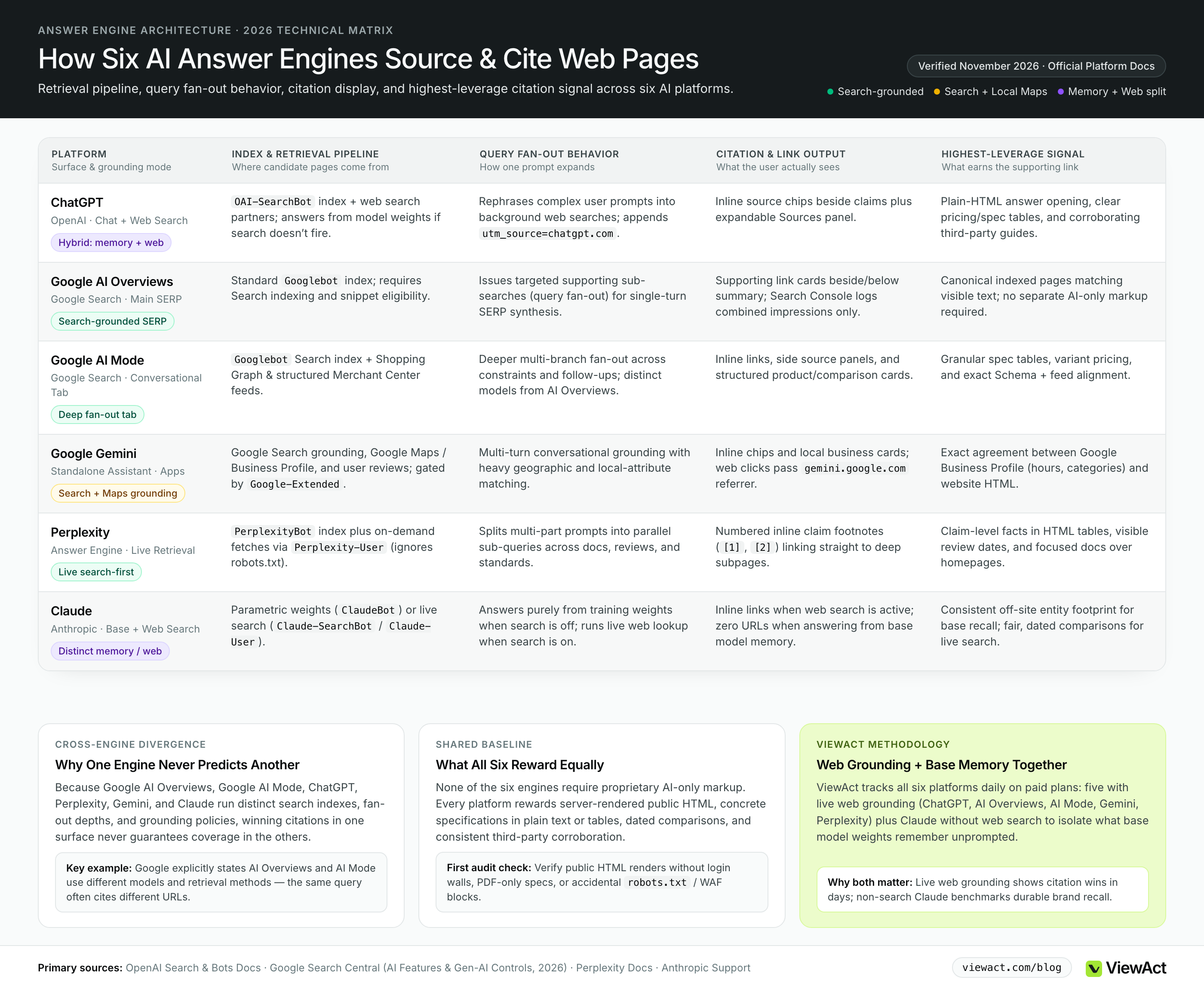
Reference ChartVerified November 2026 from official OpenAI, Google Search Central, Perplexity, and Anthropic platform documentation. Free to save or cite with attribution.
Answer engine optimization (AEO) is the practice of making accurate information about your business easy to find, understand, and use in an answer. Imagine someone asking for a workshop where they can learn to turn a bowl on a pottery wheel. For a studio to be a good recommendation, several details have to line up. Does the class actually use a wheel? Does it accept beginners? Can someone book a single session while visiting the city? A beautiful home page can leave every one of those questions open.
Start with one question a customer asks before spending money. Read the AI answer, check the facts behind it, then visit your own site as if you had to make the decision yourself. The distance between what a buyer needs to know and what they can verify is a good place to begin.
How AEO, GEO, and SEO Fit Together
Search engine optimization (SEO) helps people discover pages through search. AEO takes the buyer’s question as its starting point and looks at what the answer says. A page can do well in search for its own name while a buyer asking for suitable options sees a shortlist that leaves the business out.
Generative engine optimization (GEO) deals specifically with visibility inside generated responses. The researchers who introduced the term studied how changes to source material affected its visibility in answers. Their work gives publishers a way to think about being quoted or cited inside a response. An experiment on a particular set of questions can tell you what happened in that setting. Applying a finding to your industry takes a fresh test. Read the original GEO paper by Aggarwal and colleagues.
For the pottery studio, the work overlaps. A descriptive page title helps a searcher identify the class. A sentence explaining that beginners each get a wheel helps someone answer a specific question. A public timetable lets the buyer check whether a session fits their trip. The same page serves all three purposes.
How a Brand Gets Into an AI Answer
A question can contain several searches’ worth of work. Someone asking for a pottery class they can take on holiday may care about class length, the teaching language, and how to get a finished piece home. Google says its AI search features can issue related searches while composing a response. ChatGPT can also search the web and rephrase the user’s request when looking for sources. A page about shipping finished pieces could therefore be relevant to a question whose wording never mentions shipping. Google Search Central on AI features and OpenAI on web search in ChatGPT.
Read an answer at three levels. A mention means the business appears by name. A recommendation gives the buyer a reason to consider it for this particular need. A citation points to a source. A city guide can be cited for recommending your class even when the reader never sees your domain. Conversely, an answer can cite your explanation of kiln firing and recommend a different studio for lessons.
Open the source next to the claim. If a guide calls the studio suitable for visitors, find out what it actually says about scheduling and collection. An assistant may have combined details from several places or drawn a conclusion that the source cannot support. You can investigate the evidence a reader sees. The private selection process behind an individual answer remains uncertain.
Choose a Question Your Business Can Genuinely Answer
Look at the messages people send just before a booking, purchase, or trial. The words after “as long as” often reveal the decision. A class is suitable as long as a visitor can attend alone. A piece of software is suitable as long as a client can approve work without buying a seat. Remove personal details and keep the constraint when writing a test question.
Separate discovery from verification. “Where can I try wheel throwing during a weekend visit to this city?” tests whether a studio appears among the options. “Will this studio ship my fired bowl overseas?” tests what people learn once they know its name. Keep both. Improving a shipping answer can help someone who has already found you, even if the discovery shortlist stays the same.
Choose a question whose answer would change a decision. Ask the person who handles bookings what happens when someone misunderstands that detail. A visitor turning up for wheel throwing at a hand-building class is a specific failure you can fix. A broad aspiration to be known as a creative destination gives the editor much less to work with.
Publish the Facts Together on the Page a Buyer Would Use
Take the wheel class page. Describe who can attend, what equipment each person uses, what the fee covers, and what happens to the work afterward. Put a limitation beside the promise it qualifies. If overseas delivery requires a separate quote, say that next to the collection details and give the reader a way to request one before booking.
Use the format the decision needs. A timetable works for dates. A short paragraph works for explaining why firing takes time. A comparison table helps when someone must choose between wheel throwing and hand building. Label the rows with differences people actually ask about, such as whether the session is suitable for children or whether two people can share a wheel. Someone reading one row in isolation should still understand which class it describes.
Link the answer from the place where the question occurs. A shipping policy buried under general terms is easy to miss during booking. A short explanation and a link from the booking page give a visitor a route to the full conditions. Before publishing, ask a colleague unfamiliar with the class to plan a visit using only the public pages. Write down where they have to ask you for help.
Check Access and the Sources Beyond Your Site
Open the relevant URL in a signed-out browser. Can a visitor read the answer without creating an account, entering a postcode, or downloading an image of the terms? Keep important facts in visible text and link to the page from another public page. For Google AI search features, a supporting page has to be indexed and eligible to appear with a search snippet. Also check that the property is included in Search generative AI features. The Google AI Overviews guide shows where to find that setting. Google Search Central’s eligibility guidance.
Start with the AI crawler checker to see which automated visitors your site’s public rules allow. OpenAI documents distinct crawlers for search and potential training use. Read the rule for the crawler you intend to allow, and check whether your hosting service presents it with a challenge. An allowance in robots.txt answers one question about access. It leaves indexing, source selection, and the wording of the final answer to the engine. OpenAI’s crawler documentation.
Then inspect the outside pages cited for your question. A tourism board might have a useful class listing with a booking link that still points to a retired timetable. Give its editor the current URL and the exact factual correction. If an independent reviewer preferred another studio for experienced potters, consider whether your own offering fits that audience. Genuine differences help readers make a choice.
Measure What Changed for the Buyer
Save the original question, the answer text, the date, the platform, the market, and the source URLs. Record what the answer let a buyer do. Could they identify a suitable session? Did it describe the collection policy correctly? Did the cited page let them verify it? Repeat the question in fresh conversations under comparable settings to see how much answers vary before editing anything.
Log your change in terms someone can check later. For example, record that the class page now explains international shipping and that the regional directory received a corrected booking link. When you repeat the check, look for those particular details. A new citation with the old shipping advice still leaves a visitor at risk of making the wrong booking. A correct explanation from an independent directory can be progress even without a direct link to your site.
For a first review, give the editor one buyer question, the answer you saved, the supporting page, and one change to make. Keep the original question for the next review so the team can see whether a prospective customer now gets a more useful answer. For a worked method that includes prompts and a scoring sheet, read How to Check if ChatGPT Recommends Your Business.
When you are ready to turn manual spot-checks into a steady baseline, draft a starter list of buyer questions with our free AI prompt generator. ViewAct can then monitor those prompts automatically — starting on the Free plan (1 brand, 5 questions on ChatGPT checked weekly, no card required) or paid plans from €29/month (excluding VAT) checking all six AI platforms daily, including ChatGPT, Google AI Overviews, Google AI Mode, Gemini, Perplexity, and Claude (which answers from training knowledge without web search). Compare plans and limits on the pricing page.
Frequently Asked Questions
What Is the Difference Between AEO, GEO, and SEO?
SEO focuses on helping people discover pages through search results, AEO starts from the buyer's question and checks what an answer says about your business, and GEO focuses specifically on how content is cited or quoted inside generated AI responses. In practice, clear, verifiable public pages serve all three.
Can I Do Answer Engine Optimization Without Special AI Markup?
Yes. Google states that no special AI markup is required for AI Overviews or AI Mode. Focus first on making key facts public, crawlable, accurate, and clearly organized in plain text on the pages buyers actually consult.
How Long Does It Take to See Results From AEO Work?
Changes to crawl access or indexed web pages can show up in search-grounded assistants once pages are recrawled and reindexed, often over weeks rather than hours. Responses drawn purely from training knowledge update much more slowly, so monitor a fixed prompt set over multi-week windows.
Free AI Visibility Tracking Sheet (CSV and Print Guide)
Download the ready-to-use run sheet with columns for Mention Rate, Citation Rate, Share of Voice, sentiment, and accuracy — or subscribe for new guides and templates.
Check Your AI Visibility
Start free with 5 ChatGPT questions weekly in ViewAct, or test which AI crawlers your website allows.